


There are more slang words for inebriation than there are for any other word in the English language.
This not only illustrates the creative effects of alcohol, it also speaks volumes about how alcohol has impacted the language in general.
When the English language was a mere lad and still closely tied to the mother tongues from which it sprang, it did what a lot of young men do when they start itching for independence and a life of their own. It started hanging around a pub.
Fortunately it fell in with a bright crowd. The individuals who’ve had the most obvious impact on the English language, men such as Geoffrey Chaucer, William Shakespeare and Samuel Johnson, not only used the pub as a meeting place, they also did some of their best work there. Bolstered by beer and booze, these smart boys played it very fast and loose with the lingo, as we all do when last call rolls around. The difference being, people paid attention to these wordsmiths. The pub served as a simmering pot in which new cant and old Latin were well mixed with drams and pints, stewed, strained, and eventually served up to the public in the form of plays, poems, novels and dictionaries.
Soon the young language was not only standing on its own two grammatical feet, it also possessed the largest vocabulary of any language on the planet. And no wonder. For when are we at our most loquacious, when are we most willing to take liberty with the lingo than when we’re on a hoolihan, tossing back pots, and three sheets to the wind?
A
alcohol The word for the thing that makes us so happy started out as an Arabic word describing a fine metallic powder used as eye shadow (al-kuhul). The word was broadened to mean “the pure spirit of anything” in 1672, but it wasn’t until 1753 that it was first recorded in the sense of something you’d want to put in your mouth. Alcoholics didn’t exist in print until 1891—before then our gang went by the less clinical names tosspots, topers and soaks.
B
bar An abbreviation of barrier, it naturally came to describe the counter that separated the drinks from the drinkers. Near the end of the 16th century it came 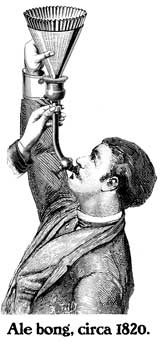 to mean the building that housed that bothersome barricade as well. Barmaid didn’t appear in print until 1772, bartender arrived fifty years later and the barfly didn’t start hassling them for free drinks until 1910.
beer bong Drunks may have filched bong from the hippies, but the hippies lifted it from Vietnam veterans (from the Thai word baung, meaning “a cylindrical wooden tube”.) The Flower Children weren’t above borrowing from the squares at the bar either—high and stoned meant being drunk long before they were applied to marijuana use.
bender Some believe a drinking spree is called a bender because a lot of bending of the arm is required. Others assume it refers to the bends one might experience after a long bout, which is unlikely as benders were being executed as early as 1846, fifty years before the bends appeared in print. More likely it owes it name to an obsolete British coin, the sixpence, commonly called a bender because they were made of silver and could be bent, as a test of their authenticity. To go drinking on a 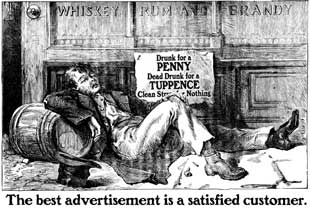 sixpence or bender meant you were loaded for bear (or beer, if you will). A popular pub sign of the day read: “Drunk for a penny, dead drunk for tuppence, clean straw for nothing.” Which meant you could stay loaded for six days or really tear it up for three. Either way, you got a nice bed of clean straw to pass out on. Now that’s hospitality.
binge Originally meaning soak (as in soak up some booze), it became a dialectal term meaning to drink heavily in 1854. It wasn’t until the 1910s that it became associated with eating and shopping. So the next time you decide to get loaded, inform your spouse you’re going on an “old-school shopping binge.” Which can roughly translate into “shopping to drink heavily,” or barhopping. Just don’t tell her that.
blackout Believe it or not, the sense of losing your memory predated by a year the idea of killing the lights to confuse enemy bombers. Both senses of the word lifted the idea from the theatrical term meaning “a darkened stage.” Next time your friends accuse you of theatrical behavior during a blackout, you may smugly reply, “Well, duh.”
Bloody Mary Two distinguished bartenders lay claim to this archetypical hangover slayer. Fernand Petiot said he came up with idea of combining tomato juice and vodka at Harry’s New York Bar in Paris in 1926, then added the spices later in New York. George Jessel, on the other hand, swore he threw it together at a friend’s Palm Beach home in 1927. What both men can agree on is the cocktail was not named for the violently anti-Protestant Queen of England, Mary Tudor. Petiot said an American customer told him the new cocktail reminded him of a woman named Mary who hung out at the Bucket of Blood Club in Chicago. Jessel claimed it was named in honor of heiress Mary Brown Warburton, who happened to walk in on the cocktail’s inauguration. According to the story, she spilled some of George’s prototype on her gown and thus exclaimed, “Now, you can call me Bloody Mary, George!” Sounds a bit anecdotal to me (a legendary raconteur, George had a wild story about nearly everything), so I’m siding with Fernand.
blowout The word may smack of the 1970s, but it came to mean a “big, loud party” as early as 1824. Probably a play on the term blow up, as a properly-executed blowout is easily as loud and expansive as an explosion.
boilermaker Short hand for boilermaker’s delight, a 19th Century slang term for a type of cheap whiskey favored by the craftsmen who built and maintained boilers. They called it such because the liquor was thought capable of cleaning the scales from the inside of a boiler. Which explains why the delight was eventually dropped in favor of a beer chaser.
bootlegger In the 17th century a bootleg described the upper part of the rather tall boots popular at the time. It was also popular (amongst English smugglers anyway) to hide bottles of untaxed booze there. The term was later affixed to the enterprising chaps who dealt in illicit alcohol during U.S. Prohibition.
booze It’s a common misconception that the word was borrowed from a brand of whiskey sold by one Mr. E.S. Booz in the 1800s, but it is actually a much older word. The 1529 Oxford dictionary defined it as “affected by drinking,” and it is most likely a derivative of the Medieval Dutch word busen, meaning “to drink heavily.” Benjamin Franklin seemed rather intrigued with the word, the Founding Father listed boozy as one of his 225 synonyms for “drunk” and was the first to put the word boozed (drunk) in print.
bouncer Drunks who reckon doormen are bullies are more right then they know. While personal experience has led some to think the word comes from a bouncer’s desire to bounce their victims off the sidewalk like a rubber ball, in truth it comes from the 13th Century word bounsen, which means “to thump or hit.” Which explains why the first recorded use of bouncer (1833) described a common bully. It was a tidbit in an 1883 edition of the London News that forever attached the word to the guy defending the saloon: “When liberty verges on license and gaiety on wanton delirium, the Bouncer selects the gayest of the gay, and—bounces him!”
brannigan This colorful and increasingly popular term describing a drinking spree probably owes its life to the popular 1820 Irish ballad “Barney Brannigan” (sometimes Barney Brallaghan), in which the eponymous hero rouses his heart’s true desire at two in the morning with promises of whiskey and wine. The term was immortalized in Emily Bronte’s wildly popular book Wuthering Heights when Heathcliff declared to Cathy, “Excuse me m’dear, but I shan’t be in for supper this evening as I’m off out on a prolonged brannigan with the boys.”
BYOB This abbreviated request to bring your own (whether it be beer, bottle or booze) didn’t always pertain to poorly-stocked parties. Before the drunks hijacked the term in the 1950s, and as far back as the 1800s, it meant Bring Your Own Basket. To the picnic. Who says we aren’t becoming more civilized?
C
 carouse This well-traveled word entered the English lexicon as a corruption of the French carrousser (to quaff or swill), which in turn was borrowed it from the German garhaus, a contraction of garaus trinken (to drink up entirely.) While it now means to engage in drunken merrymaking, author R.L. Stevenson put a finer point to the word: “Dull men travail, whilst noblemen drowse. Peasants sip ale, whilst kings carouse.”
So the next time a friend abandons a half-finished drink, ask him, “Hey pal, are we just sipping like peasants here, or are we carousing like kings?”
cheers Though the Brits presently use the word for everything from “Thanks” to “Goodbye” to “‘Ello! What’s that you’ve got in that bag, then?”, it’s surprising to discover it wasn’t widely employed as a toast until World War I. The invading Normans brought the word to England in the form of chiere, meaning “face,” and because emotions are most blatantly reflected on the face, it came to mean a person’s mood or disposition. Greetings of “be of good cheer” and “cheer up” were inevitably whittled down to a cheers as early as the 1700s. It was only a matter of time before cheering up was partnered with sharing a drink with friends.
cocktail Strictly out of the blue, the word suddenly appeared in print as part of a political diatribe in the Baltimore newspaper The Balance in 1806. The writer didn’t relate where he picked it up from and theories have abounded since. It’s either named for: an old French recipe for mixed wines, called a coquetel, brought to America by General Lafayette’s soldiers in 1777; the rooster tail feathers an innkeeper in Pennsylvania employed as proto-swizzle sticks; an alcohol-spiked mash given to fighting cocks called cock-ale; a cask’s spigot was commonly called a cock and the tailings (dregs) of the cask were often mixed and sold as a cut-rate libation; mixed blood horses of the day were sometimes cock-tailed; a New Orleanian named Antoine Peychaud served brandy drinks in an egg-cup called a coquetier in French; it was a morning drink served at the time the tail of the evening met with the “cock-a-doodle-do” of a mouthy rooster.
The list goes on. Which is true? Your guess is as good as anyone’s. What is known is it was once considered a specific type of mixed drink among many others, including flips, crustas, swizzles and bittered slings. Over time, however, cocktail subjugated them all.
crapulous This expressive and sorely neglected substitute for hungover deserves a comeback (“How am I feeling today? Absolutely crapulous!”) This 18th century refugee comes from the Greek kraipale (drunken headache or nausea).
D
daiquiri F. Scott Fitzgerald first put this cocktail to print in his splendid 1920 novel This Side of Paradise. Fitz must have liked them because he had his protagonist order four doubles at once. Barroom history, such as it is, has it that American engineer Jennings Cox threw the first daiquiri together in a Cuban village by the same name. Some revisionists, with no proof but plenty of PC pluck, suggest the visiting gringo stole it from the locals who used it for “medicinal purposes.” Don’t we all, amigos, don’t we all.
dead soldier This slang for a vanquished bottle is attributed to U.S. doughboys about to be shipped off to fight the Kaiser. A soldier could be dead drunk, however, as early as 1599.
dipsomania First defined in 1843 as a “morbid craving for alcohol,” this rather compelling term was forged from the Greek words dipsa (thirst) and mania (madness). Thus a dipsomaniac suffers from thirst madness, which is as good a way to explain your next brannigan as any.
dive Seedy bars have been known as such since at least 1871, most likely because they tended to be located in basements and one had to “dive” down the stairs to get a drink. So the next time you fall down while walking in the door of a ground-level bar, just tell them your thought the joint was a real dive.
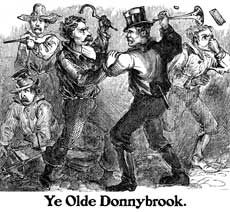 donnybrook This rather pleasant word for a drunken brawl is named for a suburb of Dublin. Since medieval times their annual fair was famous not only for its heights of bacchanalian revelry but also for the ferocious brawls that would inevitably break out. In fact, they became so inevitable they had to shut the fair down in 1855.
down the hatch This venerable drinking expression most likely owes its origins to sailors who reckoned the pouring of booze down the gullet was much like cargo being lowered into a ship’s hold via the hatch. The reverse enjoyed brief popularity during WWII, i.e.: “Mike’s in the restroom unloading cargo.”
draft/draught From the 13th century Old English word dreaht (to draw or drag), as in drawing beer from a keg. It can also mean “to drink” as in “If I draft enough drafts tonight you’ll have to draft me home.”
drunk First recorded as an adjective around 1340, an alteration of the Middle English drunken, from the verb drincan, which in turn arrives from the Old High German word trinkan (to drink.). Drunkard didn’t appear until the 16th century and this too was abbreviated to drunk around 1852. It’s a fairly versatile word when you think about it: “The drunk drunk so much he got drunk and went on a drunk.”
Dutch courage Due to a fierce 17th century commercial rivalry, the Dutch aren’t treated well in the English language. Thus a Dutchman needs alcohol to make him brave, a Dutch widow is a prostitute, and going Dutch smacks of stinginess.
E
eighty-six This unluckiest of numbers (at least as far as drunks are concerned) has a very clouded history. It either means: the staff doesn’t want to see your face for as many years; a standard crew on British merchant ships in the 19th century was eighty-five, meaning the eighty-sixth sailor was left on shore with the land-lubbers; there were 85 tables at NYC’s famous Twenty-One club and to be offered a seat at “table 86” meant you were about to get tossed out; a grave is generally eight feet long and six feet deep; back in the Old West 86-proof whiskey was considered weak and strictly for the ladies, so to serve it to a man was a subtle way of saying, “You ain’t wanted ‘round here, pard”; it was verbal shorthand used at lunch counters for being out of something, as in, “Eighty-six the pancakes” and was later applied to customers who were plain out of luck.
So which theory is correct? Well, since it wasn’t associated with being cut off at a bar in print until 1943, you can rule out the Old West and nautical theories right off the bat, or boat, if you will. As far as the staff not wanting to see your face, why would they choose 86 years, why not 100, just to be safe? The grave theory seems too pat and the club theory too clever. The lunch counter numerical code, however, has been proven to have existed as early as the 1930s, and thus seems the most likely source.
F
fifth If a hardboiled P.I. is pounding a fifth he’s taking down a 1/5 of a gallon of liquor and probably trying to forget the dame who did the tap dance on his ticker. The term didn’t become popular until the 1920s and is presently being undermined by the liquor industry’s fetish for the metric system. Nowadays if you ask for a fifth, you’re likely to receive a much less hardboiled 750 ml.
foofoo/froufrou drink The word frou-frou was first recorded in the early 1870s, describing the rustling sound a woman’s dress might make. It soon came to mean “an elaborate or frilly decoration, as on women’s clothing.” By WWII the expression frou-frou drink appeared, used to describe a fancy woman’s drink (especially when held in the hand of a male friend). Twenty years later the even more emasculate foofoo variation surfaced.
G
go on a tear The phrase doesn’t make a whole lot of sense, in relation to going on a drinking spree, until you realize that tear hails from the Old English teran, meaning “to consume or destroy.” Both of which are apt to happen during a proper tear.
grog Traditionally a mix of rum and water, it was named for the moniker of the 18th Century Royal Navy admiral who came up with the smashing idea of serving it to the sailors to keep them in good spirits. Admiral Edward Vernon was nicknamed “Old Grog” from his habit of wearing a type of cloak called a grogram.
growler The refillable glass jugs you’re allowed to walk out of microbreweries with were once metal buckets. In pre-Prohibition times it was common for fathers to dispatch their progeny to the saloon with a growler to collect beer, and it was probably named for the growling sound a metal bucket full of beer makes when pushed across a bar top. The once popular term rushing the growler meant a hurried beer run—beer in a bucket tends to lose its head rather quickly and dad probably preferred it didn’t.
H
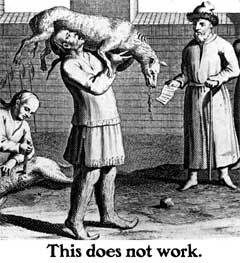 hair of the dog that bit you. This metaphor first surfaced in a 1546 collection of English colloquial sayings: “What how fellow, thou knave, I pray thee let me and my fellow have a haire of the dog that bit us last night. And bitten were we bothe to the braine aright.” We all know what that feels like. The homeopathic idea of taking a little of what afflicted you as a cure can be traced all the way back to Hippocrates. The ancient Greeks were much more literal in their application, believing that a dog bite would heal more quickly if you ate or applied dog hair to the wound.
hangover While it’s easy to associate the word with the image of some poor suffering drunkard hanging his head over a sink, it was originally a 19th century expression describing unfinished business—something left over from a meeting, for example. It wasn’t until the turn of the 20th century that it came to mean the aches and pains left over from a night of carousing.
here’s mud in your eye This toast may have been popular with the soldiers slogging through the muddy trenches of WWI, but it did not originate with them, as many believe. It was being bandied about in U.S. saloons as early as 1890 and was popular with the English fox hunting and race horse crowd before then. Most likely it’s a back-handed toast among jockeys, meaning “Here’s to you losing the race.” If you’ve ever been to a race track after a good rain, you’ll note that the leading horses throw up a lot a mud and the trailing jockeys tend to get splattered from head to toe. The phrase was all the more pertinent before the introduction of goggles to the sport.
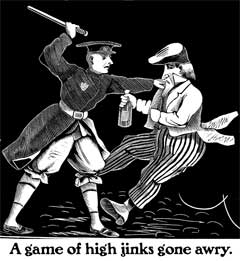 high jinks This term for boisterous carryings-on once referred to a popular 17th century drinking game. A group of drinkers would throw dice and whoever came up short would be encouraged to perform some manner of debauchery, such as drinking a large flagon of ale while being held upside down or stealing a constable’s hat.
highball First appearing in print in 1898, highball came about because a shot of whiskey was once commonly called a ball, thus a highball was a high or tall glass of whiskey. It was later applied to the glassware required to deliver such a drink.
hooch A derivative of hoochinoo, a liquor named for the Alaskan Indians who distilled it. A favorite beverage of the prospectors of the 1898 Klondike gold rush, they brought back the abbreviated version to the lower 48 and applied it to any cheap liquor they could get their hands on.
hoolihan/houlihan This term for a proper booze binge surfaced in the 1890s, possibly based on the surname of a proverbially rowdy London family who figured in a number of ribald saloon ballads of the era.
I
imbibe Though the Classical Latin source imbibere (to absorb) was used mainly in reference to absorbing ideas or knowledge, by the time it reached England in the 1500s it meant to absorb liquids by way of the mouth.
intoxicate Being intoxicated in 15th century England wasn’t nearly as joyful as it is now — it literally meant you were full of poison. At some point a nogoodnik decided sweet nectar alcohol was a form of poison and it came to be applied to hale fellows who just happened to be walking a little funny.
J
jag If you went on one of these in the 1500s it meant you were climbing up on a load of hay or wood. By the 19th century it was generalized to mean “a lot of anything,” then was later applied to a period of unrestrained activity, especially in regards to drinking, i.e. a lot of fun.
jigger Most contemporary drinkers don’t think much of the miserly jigger measurement technique, preferring the more generous free-pour system, and our predecessors apparently felt the same way — jigger is a snarky 1753 alteration of chigger (tiny mite or flea).
jukebox The title for this barroom stalwart arrived in a roundabout way from the 1930s Black American slang jook (meaning wicked or disorderly). Jook was often paired up with joint, and since jook joints were among the first to accept coin-operated phonographs, the contraptions came to be known as jook (later juke) boxes. Bartenders (after they’ve heard the same song for the nth time) can surely attest to their wicked roots.
K
karaoke This most venal side-effect of excessive drinking comes from the Japanese words kara (empty) and oke (orchestra).
katzenjammer Still used today by Germans to describe a hangover (it literally means “wailing cat”), it was also quite popular in mid-19th Century America and long overdue for a comeback.
L
libation If this word strikes you as a bit high-falutin, it may be because it formerly cited the act of pouring out wine in honor of a god. Though the idea is still echoed in the pouring out of forties for dead homies, most modern drinkers reckon the gods can buy their own drinks.
liquor Getting liquored up in the old days wasn’t nearly as much fun as it is now—the original Latin (liquorem) meant any liquid in general. It wasn’t until 1300 that it came to mean something you were wise to hide from your castle-mates.
loaded The term may seem modern, but “to take one’s load” meant “to drink one’s fill” as far back as 1598.
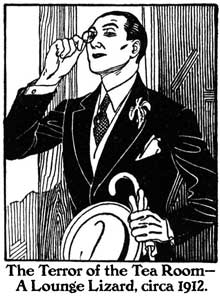 lounge First put to page in 16th Century Scotland, it probably came from the French phrase s’allonger paresseusement (to idle about). It came to mean a “comfortable drawing room” during the 19th century. Lounge lizards appeared decades before upscale bars started calling themselves lounges in the 1930s — as far back as 1912 these crafty scoundrels could be found loitering around tea rooms and flirting with unattached females.
lush By the time the word was used to describe a drunkard (1890), lush had already spent a century serving as a slang term for liquor. Most likely it comes from the Old French laschier, meaning “to loosen.” And who’s more loose than a lush?
M
martini Success attracts many suitors and the martini has enough to fill a dance hall. H.L. Mencken called it “the only American invention as perfect as the sonnet” and with that kind of write up it’s no wonder there are as many would-be inventors of this cocktail as there are for the, well, cocktail. Ranging from the plausible to the patently ridiculous, the fact that the original martini was most likely made with Martini and Rossi vermouth seems too large a coincidence to ignore.
moonshine Though it is now thoroughly attached to the illicitly distilled corn liquor indigent to the southern U.S., the term originated in England. The 1785 edition of the Dictionary of the Vulgar Tongue defines it as “white brandy smuggled on the coasts of Kent and Sussex.” Smugglers tended to do their best work by the light of the moon, thus their product came to be known as moonshine liquor. The word crossed the Atlantic in the mid-1800s and became popular in the South as increasingly heavy liquor taxes encouraged distillers to operate underground.
N
nightcap The once popular idea of having a stiff drink before retiring is in reference to the idea it would keep you warm, much as the stocking nightcaps of the day were used to keep a sleeper’s exposed head warm (this was before central heating).
O
on the cuff Waiters and bartenders of the early 1900s 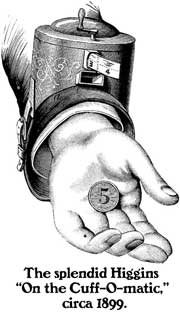 would often keep track of running tabs by making pencil marks on the stiff cuffs of their starched white shirts, so “on the cuff” came to mean “on credit.” Considering the forgetful nature of drunks, it’s little wonder it later came to mean “on the house.”
on the house This most heart-warming of expressions popped up in print in 1889. The house being referred to was a public house, longhand for pub.
on the wagon Though it didn’t appear in print until 1904, this defeatist phrase existed in earlier forms as “on the water-wagon” and “on the water cart.” The temperance movement of the time would take the figurative to the literal and drive water wagons from saloon to saloon, encouraging drunkards to get on board and savor some aqua pura. Which some of them no doubt did, especially if they needed a ride to the next saloon.
P
paint the town red First recorded in 1884, this phrase for a wild night on the town may have a much darker history. At the height of the Roman Empire, their soldiers made a habit of painting the walls of a conquered village or town with the blood of the vanquished. Alternative sources say it was a metaphor for putting the torch to a town. You know, just for fun.
party A party originally meant solely “a person or individual” but by 1716 it also came to mean a gathering of parties for social pleasure, for a party of one is rarely any fun. The verb sense of the word appeared in the early days of Prohibition, party pooper popped up in 1951, and tailgate party started being used in 1970 to describe what the drunks in the parking lot were up to.
pass out In the 1800s it meant the same thing as the euphemism pass on, as in “Children, your father has passed out of this world.” By 1915 it came to mean the current, more temporary departure from this earthly realm.
plastered While humans have been getting drunk since time eternal, they didn’t start getting plastered until 1912. Before then plaster meant “to apply a remedy to; to soothe.” And what remedy is more soothing than a good dose of liquor?
pub An abbreviation of public house, which originally meant “any building open to the public” (1574). By 1669 the public house became an “inn that provides food and is licensed to sell ale, wine, and spirits” and fully transformed into what we think of as a tavern in 1768. The first printed mention of a pub crawl appeared in 1910.
puke Drunkards were puking as early as 1598. Probably a derivative of the German word spucken (to spit), it first appeared in print in Shakespeare’s As You Like It: “His acts being seven ages/At first, the infant, mewling and puking in the nurse’s arms.” Strangely, it wasn’t recorded as a noun for the physical manifestation of puking until 1961. The word’s relative up chuck appeared around the same time: chuck meaning “to throw,” thus a slangy reversal of throw up.
R
rail/well drinks While western states tend to use well to describe uncalled liquor, the East prefers rail. Both names come from where the bottles are stored: the easily accessed rack directly behind the bar. In some cases the rack is a metal enclosure with a drain (a well) and other times its a shelf with a rail to keep the bottles in place.
red eye The White Mule Distillery put out something called Red Eye Whiskey in the latter part of 1800s, but American frontiersmen were ordering shots of red eye as early as 1819. Hollywood cowboys brought the colorful term back to life, but where did it come from? Some insist it was raw whiskey that often left you red-eyed in the morning, others say it was named for its crimson tint, which, in lieu of aging it in a barrel, saloon keepers would conspire by adding whatever was on hand, including soap, red ink, red peppers, chewing tobacco, Jamaica ginger, tea, coffee, molasses and bitters.
rotgut While it’s easily understood why our forefathers called cheap, harsh liquor rotgut, it is surprising to learn how long the word has been around. Long before the victims of Prohibition complained about having to drink “bootleg rotgut that would kill a herd of buffalo at fifty feet,” drunkards were gritting their teeth and calling “unwholesome liquor” rotgut as far back as 1633.
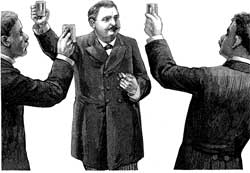 round This has meant “a quantity of liquor served to a company at one time” at least as early as 1633. It is most likely called such because it was (and is) customary to drink them in a circle facing one another.
rum Originally called rumbullion (1651) by Richard Ligon, an American who happened upon the stuff in Barbados. His review wasn’t exactly glowing: “Rumbullion alias Kill-Devill . . . is made of suggar cane distilled, a hott, hellish and terrible liquor . . . will overpower the senses with a single whiff.” The world rumbullion formerly existed as either Royal Navy jargon for “an uproar” or Creole slang for “stem stew” (it’s not difficult to imagine the uptight Mr. Ligon applying either meaning to the devilish liquor.) It was shortened to rum three years later, but its reviews didn’t get any better — in 1654 a General Court Order was issued in Connecticut to seize and destroy “whatsoever Barbados liquors, commonly called rum, Kill Devill or the like.” Demon rum was first coined by Timothy Arthur in his 1854 temperance play “Ten Nights in a Barroom,” and it wasn’t long before the phrase came to describe all forms of “evil” alcohol.
S
saloon An Anglicized version of the French salon (a large public hall), it took 19th century Americans to turn it into the type of place you wouldn’t mind spending all your free time in.
shot This came to mean a drink of straight liquor as early as 1676, probably an analogy of the kind of shot fired from a cannon. Since many of the drinking vessels of the day were metal cylinders, it’s easy to make the association, except this sort of shot you didn’t try to duck (not without your friends calling you a sissy, at least.)
skid row Seattle natives will insist it’s actually Skid Road, after their still existing street, but they forget nearly every logging community of the 19th and early 20th century had their own skid row or road. So called because the road leading from a lumber camp was generally laid with wooden skids to facilitate the rolling or skidding (dragging) of freshly cut timber, usually in the direction of a river or mill. Loggers tended to build temporary shanties along the road and thus skid row came to mean “a part of town inhabited by loggers” around 1906. When all the local timber was harvested, the loggers would move on, leaving their ramshackles behind, and by 1915 skid row came to mean a cheap, disreputable district, usually populated by dives and dipsomaniacs. The term on the skids has a similar origin: skid roads were generally built on a downward slope and once you were on the skids you were heading downhill at a steady pace.
sloshed In 1844 slosh meant “to splash about in mud or water”, and 30 years later it arrived in the saloons and came to mean “to pour carelessly.” Sloshed as in inebriated appeared around 1900, undoubtedly because you’re likely to slosh your drinks while sloshed.
slur From the Medieval East Frisian sluren (to go about carelessly), it was eventually applied specifically to the careless (I prefer carefree) speech of drunks during the 19th century.
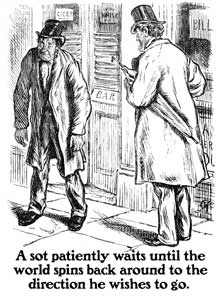 sot Originally sott, this Old English term (borrowed from the French) was directed at a stupid or foolish person, though not necessarily drunk. It wasn’t until 1592 that this insult stuck to those who were “stupefied with drink.” So the next time someone accuses you of being a “drunken sot,” tell them, “Yes, but you’ve managed it sober.” Zing!
souse As early as 1387 this meant “to pickle or steep in vinegar.” It was applied to drunks at the beginning of the 17th century, based on the idea they were pickled in alcohol. Which, if you’ve ever mistaken vinegar for cooking sherry, is a far better thing.
speakeasy Though they became popular during Prohibition, drunks were sneaking into unlicensed saloons called speakeasies as early as 1889. Though opinions differ, the most logical theory suggests patrons were encouraged to speak easy (or softly) while talking about or actually in the saloon, as loud conversations tended to attract Johnny Law.
swill The verb sense is a derivative of the Old English swillan (to gargle), and came to mean “to drink greedily” at the beginning of the 16th century. To call beer swill is to compare it to “liquid refuse fed to pigs” (1553), which may bring to mind more than a few keggers you’ve attended.
T
 tab This small, unassuming word (that so often plays David to our wallet’s Goliath) didn’t start out that way. Before it was abbreviated in 1889 it went by the ringer tabulation. It’s easy to see why it was shortened—you can imagine the drunken snickers to the bartender’s cry of “Who in tarnation is gonna pay this tabulation?”
tavern If you think you’re insulting your local tavern by calling it a boarded-up shack, think again. First appearing in print in 1286, tavern initially meant a wine shop; it didn’t become a proper place to drink until around 1440. From the Old French taverne, a type of shack or shed made with boards.
teetotaler The source of this term for a person so determined to not have fun he will even refrain from drinking is a bit murky. Some believe it makes reference to those determined to drink only tea as a beverage, but it seems unlikely they would suddenly forget how to spell their preferred beverage. The more likely theories are 1) it was used in a speech by a temperance leader in England (1833) in the form of T-total (some say he stuttered, but he later swore he was merely emphasizing how totally abstentious he really was); and 2) signing a temperance pledge originally meant you would only refrain from hard liquor (beer and wine were still kosher), but a NY temperance society started the fad of putting a T next to their signatures, inferring they would be totally temperate. The admonishing term teetotalitarian first appeared in Somerset de Chair’s 1947 satire The Teetotalitarian State.
three sheets to the wind While it’s easy to think of sheets as sails, they were actually the ropes used to adjust a sail’s position. Since most ships of the day (the expression emerged in the 1700s) had three masts, if all three sheets became untied and were blowing in the wind, the ship’s course would become very erratic indeed. Thus, being three sheets to the wind evokes the image of being out-of-control drunk and most likely drifting in the direction of Blackout Island.
tie one on First recorded in 1951, this phrase for getting 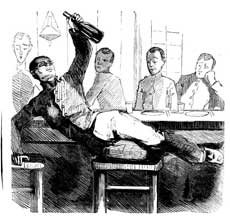 smashed begs the question, “Tie what on?” Why, a bun, of course. Until the 1950s, bun was commonly used in place of bender (it still is in the U.K.). Tie a bun on (compare to the contemporary phrase get your drink on) predates tie one on by 50 years, but when bun fell out of favor, it fell out of the phrase as well. Bun, by the way, is most likely a corruption of bung, archaic Scottish slang for intoxicated.
tight Though this word for drunk isn’t used much anymore, pick up any book by F. Scott Fitzgerald or Ernest Hemingway and you’ll discover it was quite popular with the Lost Generation set. First substituted in print for drunk in 1830, it may be related to the bygone expression “tight enough to burst,” meaning very full (of booze, say) indeed.
tippler In the 14th century a tippler was a seller of liquor rather than an avid consumer. Perhaps related to the Norwegian word tipla (to drink slowly), it came to mean a habitual drinker 200 years later. Tipsy, or slightly intoxicated, was used to describe the natural state of the tippler as early as 1577.
toast Originally a toast specifically meant to salute the health of a certain beautiful or popular woman (literally, she was the toast of the town). Spiced toast was used to flavor the drinks of the time, and the original toasters declared the woman’s charms spiced the drinks more than any silly piece of dried bread.
tosspot This rather quaint name for a drunkard describes what they called fun: our 16th century brethren tossed back pots (a pot was a type of drinking vessel), much as modern inebriates throw back shots.
tumbler Though now it means an unadorned drinking glass, the original tumblers (circa 1700) were called such because they had a rounded bottom, making it impossible to set it down without it tumbling over and spilling. It was undoubtedly designed to encourage guests to keep their minds on what’s at hand.
U
under the table There was a time when all under-the-table dealings were conducted by drunks. The first mention of alcohol inducing one to this low, but perhaps happy state is from 1921—it wasn’t until thirty years later that it came to mean doing something in secret.
W
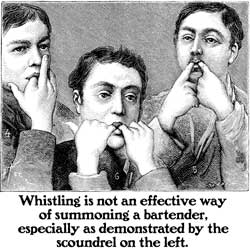 wet one’s whistle Many believe this refers to whistles that were baked into the handles of 17th century drinking mugs (so as to alert the bartender to your thirst), but this seems rather unlikely. Contemporary bartenders will bristle at the mere snapping of fingers (can you imagine how they’d react to a roomful of shrill whistles?) and their forerunners were probably no different. If I may unsheathe Occam’s razor, the simpler and much more likely explanation is that it’s merely a humorous reference to wetting one’s mouth (ever try to whistle while parched?) with a nice drink. Chaucer’s Canterbury Tales describes a gentlelady who had partaken in more than her share of ale as: “So was her jolly whistle well y-wet.”
wingding This amusing slang for a wild party (since the 1940s), was formerly 1920’s hobo slang for a fake seizure executed with the intention of attracting sympathy and perhaps a little pocket change.
white lightning First applied to “cheap, raw whiskey” in 1781, it is generally thought to be called such because raw, unaged whiskey is clear (or white) and tastes like, well—if you’ve tried it you know, if you haven’t you can probably guess.
—Frank Kelly Rich